DAWNSTAR II
Overview
ME 370, Team 33 · UIUC
Skills used: Klann linkage design, gear-train design, CAD, FEA, 3D printing, laser cutting, motor control, payload mechanism design, terrain testing, team coordination.
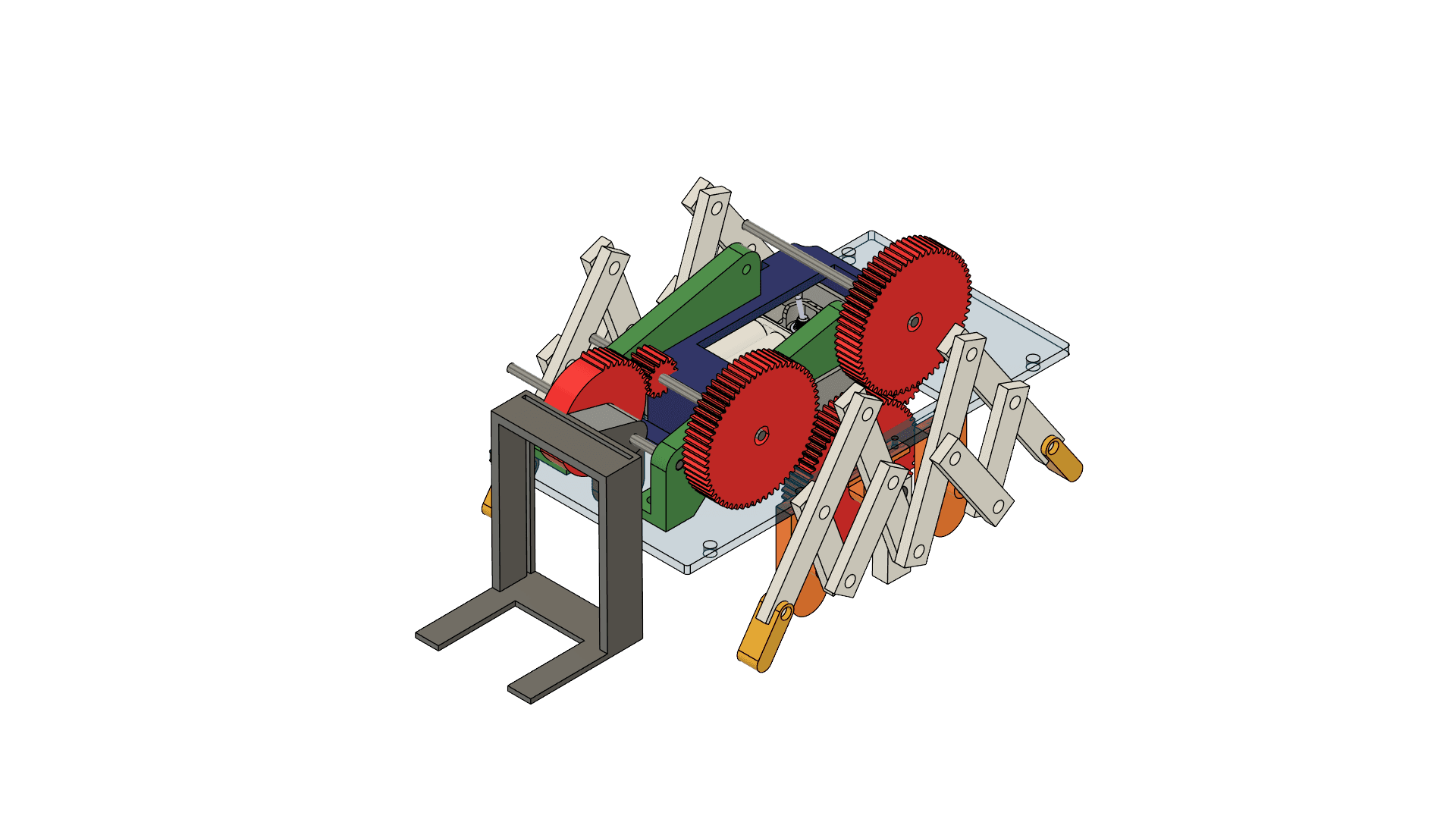
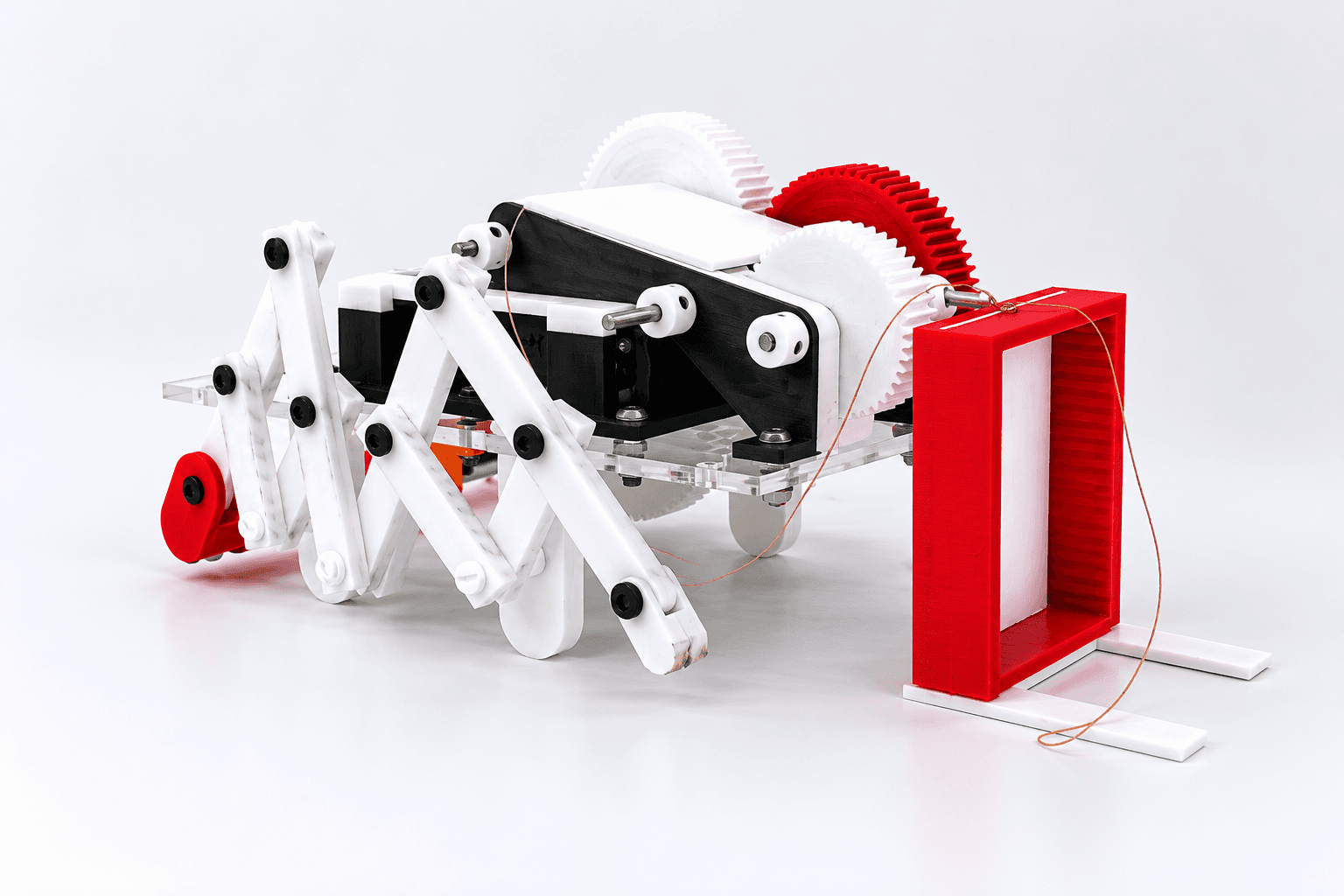
An autonomous four-legged walker driven by a single 12V DC motor that picks up a payload, traverses turf, pebbles, and hills, then delivers it to a drop zone.
Phase 1: Requirements & Concept. Worked within an 18×30×30 cm volume, a single-motor power budget, and a no-wheels, no-Jansen-linkage constraint. Designed for Path 2 (turf, pebbles, hills) and chose a four-leg layout to maintain four ground-contact points throughout the gait.
Phase 2: Locomotion Design. Selected a Klann linkage for a lifting gait so feet step over terrain instead of dragging. Relocated the rocker-arm ground attachment to the lower linkage apex to trace the correct foot path. Phased both crankshafts together so front legs extend while rear legs push.
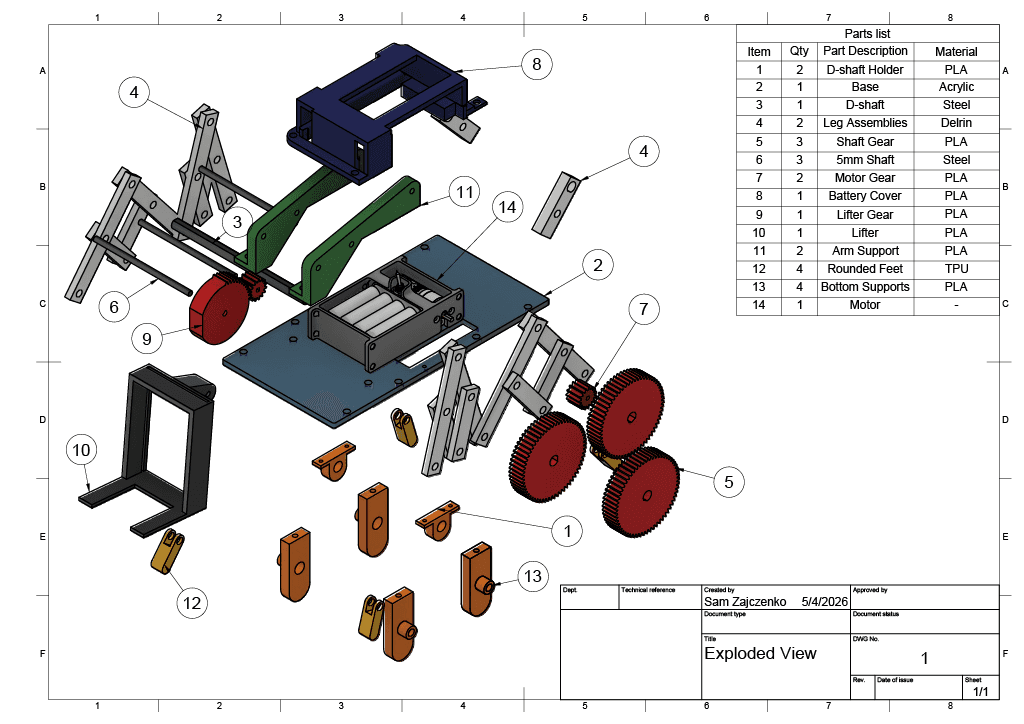
Phase 3: Payload System. Designed a forklift-style grabber with two rectangular teeth engaging the T-shaped payload. A partial gear with teeth on only one quarter of its circumference lifted the grabber into a holding position before disengaging. A string-driven trapdoor on the back of the lift housing handled the release.
Phase 4: Gearing & Timing. Drove the walking crankshaft through a 4:1 spur reduction for torque. A second 4:1 reduction drove the grabber so the payload lifted during initial travel and released near the unloading zone. Theoretical walking speed worked out to about 3 cm/s for a 1 kg robot.
Phase 5: Fabrication & Assembly. Built the legs from a repeatable printed design for easy replacement. Laser-cut the acrylic base and assembled the Klann linkages, gearbox, and lift housing around it. Added a rigid crossbar between the rear legs for stability.
Phase 6: Testing & Outcome. Walked all three terrains at a measured ~2 cm/s. Pebbles ran cleanest, turf showed minor path deviation, and hills caused occasional slipping. The robot ended up slightly over the 30 cm length limit, and the string trapdoor failed at the demonstration after detaching and tangling with the grabber gears. Locomotion and terrain traversal worked as intended; the payload release did not.
Lessons. Validate requirements early (the team initially misread when the payload was supposed to drop), constrain string routing to keep it away from moving gears, and keep tools on hand during testing for fast fixes.
Category
Machine
Client
Year
Spring 2026